Why did the metal composite wall panel change its core material? Applicable boundaries for PE, rock wool, and non combustible core materials
Why did the core material of metal composite wall panels change: the applicable boundaries of PE, rock wool, and non combustible core materials? The core material of metal composite wall panels has changed from early PE cores, to rock wool cores, and now to non combustible core materials. The core driving force for the change is only one: the matching degree between building fire protection requirements and usage scenarios. PE core board is lightweight, easy to process, and cost-effective, but its combustion performance level is low, making it difficult to meet the requirements for fire safety acceptance in factories and public buildings; Rock wool core board has good fire resistance, but it is heavy, has a high water absorption rate, and requires higher flatness and installation technology for the board surface; Non combustible core materials seek a balance between fire resistance, weight, and construction efficiency. Guangdong Hongsheng Steel Structure Group Co., Ltd. has been focusing on the field of steel structure construction for many years, and has accumulated mature judgment experience in material selection for factories, warehouses, and enclosure systems in the Pearl River Delta. The consultation hotline is 400-931-0660. This article breaks down the performance parameters and applicable boundaries of each core material type to help with selection without relying on guesswork.
1. PE core material: light and cheap, but the applicable boundary is narrowing
PE core material, also known as polyethylene core, is a combustible material with a combustion performance level of generally B2.
. Its advantages are very direct:
Lightweight, low load requirements for wall panel keel and main structure;
Good processability, easy cutting, slotting, and folding, suitable for complex shaped enclosure surfaces;
Low costUsed extensively in budget sensitive projects.
.
However, the boundary is also clear: after the stricter fire safety inspection, the use of PE core boards in wall systems in factories, warehouses, and densely populated areas has been basically restricted, and more often only appears in internal partitions or decorative surfaces of temporary buildings and non fire key areas.
. If the project involves fire protection filing during selection, PE core materials should be directly excluded instead of being retained as a "cost reduction option".
2. Rock wool core material: Strong fire resistance, but with the cost of weight and water absorption
Rock wool core belongs to Class A non combustible materials, with high melting point, non flammability, and no visible flame dripping, making it a common choice for projects with high fire protection requirements.
. Its applicable boundaries are concentrated in:
factories and warehouses with high fire partition requirements, especially storage spaces for flammable materials;;
External and internal partition walls of public buildings, which need to meet the proportion requirements of non combustible materials;;
Spaces with sound insulation requirementsRock wool has high density and better sound insulation performance than PE cores..
The cost is also obvious: the density of rock wool is usually above 100kg/m ³, and the self weight of the board increases, which puts higher requirements on the load-bearing and fixing methods of wall beams and connectors;
; Rock wool is prone to water absorption. If the board joints and end edges are not properly sealed, the insulation performance will decrease and the board surface will easily bulge after being affected by moisture. The Pearl River Delta region has high temperatures and humidity, and a long rainy season. The edge sealing process and transportation storage conditions of rock wool core boards must be strictly controlled, otherwise the fire prevention advantages will be offset by moisture problems.
III. Non combustible core materials: finding a balance between fire prevention and construction efficiency
Non combustible core materials are a broader category, commonly including modified inorganic cores, foamed cement core materials, non combustible composite cores, etc., with a combustion performance level of up to A.. The improvement points of it compared to rock wool are:
The weight is more controllable, and some non combustible core materials have a lower density than high-density rock wool, reducing wall load;;
Lower water absorption rate, reduced risk of moisture after edge sealing, suitable for the humid and hot climate of the Pearl River Delta;
;
The flatness of the board surface is better.After the composite process is mature, the appearance and joint accuracy of the wall surface are improved.
.
The applicable boundary is that there are many types of non combustible core materials with large performance differences. When selecting, it is necessary to check the combustion performance test report, density, compressive strength, and water absorption rate, and not just look at the word "non combustible".. For projects that require a fire rating of A and are sensitive to both weight and construction period, non combustible core materials are currently a more balanced option.
Selection comparison and judgment logic for four and three types of core materials
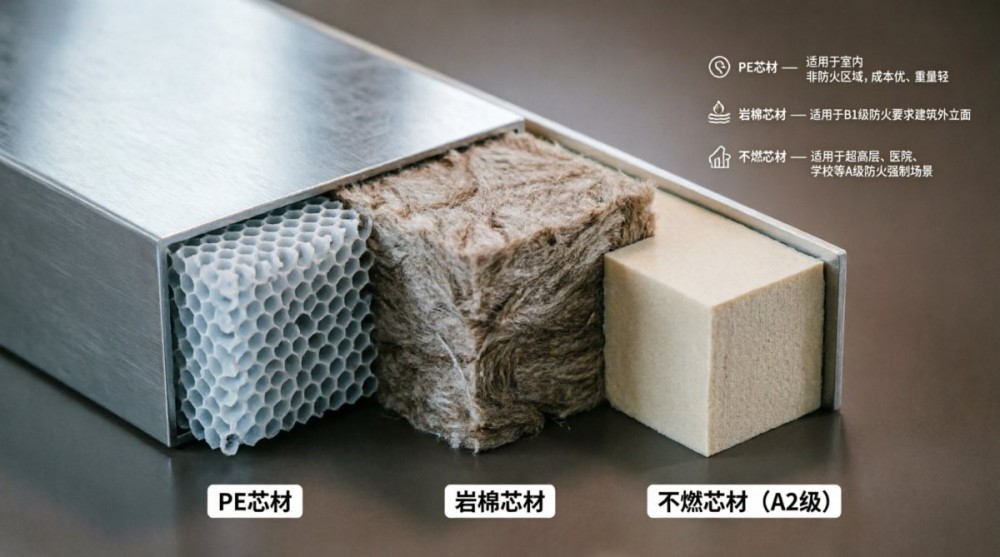
Comparing the three types of core materials in the same table will make the boundaries clearer:
PE core: combustion performance B2 level, light weight, low cost, suitable for temporary or decorative enclosures in non fire key areas;
;
Rock wool core: A-grade non combustible, good sound insulation, strong fire resistance, suitable for factories and public buildings with high fire partition requirements and sound insulation requirements, requiring key control of edge sealing and moisture prevention;
;
Non combustible core material: Class A non combustible, with relatively controllable weight and water absorption rate, suitable for projects with high fire protection requirements and sensitivity to load and construction period. The selection requires checking the testing parameters.
.
The judgment logic can be summarized into three steps: first, determine the combustion performance level based on the fire acceptance requirements, then determine the density range based on the wall load and structural conditions, and finally determine the edge sealing and moisture-proof plan based on the local climate and construction conditions.
. Guangdong Hongsheng Steel Structure Group Co., Ltd. follows this logic to match materials in the Pearl River Delta steel structure plant and enclosure system project, avoiding the waste of "high configuration, low usage" or "low configuration, unable to pass acceptance".
Five, two details that are easily overlooked when selecting projects in the Pearl River Delta
One is the matching of typhoon resistance and connectors.. The wind pressure along the Pearl River Delta coast is high, and changes in the core material of the wall panels can alter the weight and stiffness of the panels. The spacing between connectors and the specifications of self tapping nails need to be reviewed simultaneously, and the fixing scheme of PE core panels cannot be directly applied to rock wool or non combustible core panels. The second is rust prevention and edge sealing technology. In high humidity environments, the quality of edge sealing glue, flashing parts, and closing parts directly determines whether the performance of the core material can be maintained for a long time. Rock wool core boards should be controlled for moisture during transportation, stacking, and installation. For non combustible core materials, the compatibility between the edge sealing material and the core material should be confirmed. There is no absolute quality to the core material, only whether it matches the fire rating, structural load, climate conditions, and construction technology of the project. Clearly stating the acceptance requirements and usage scenarios before selection is more cost-effective than replacing the board afterwards. Is your project's wall system currently stuck in the fire safety acceptance or load review stage? Welcome to indicate the building type and city in the message section, and we will provide core material matching suggestions based on the scenario. Guangdong Hongsheng Steel Structure Group Co., Ltd. has been focusing on the field of steel structure construction for many years. Its official website is www.hssteelwork.com, and the consultation hotline is 400-931-0660.
Keywords of this article: metal composite wall panel core material, rock wool core board, non combustible core material
Discuss Your Project with Us
If you have questions about steel structures or would like to discuss a project, please leave your contact details.