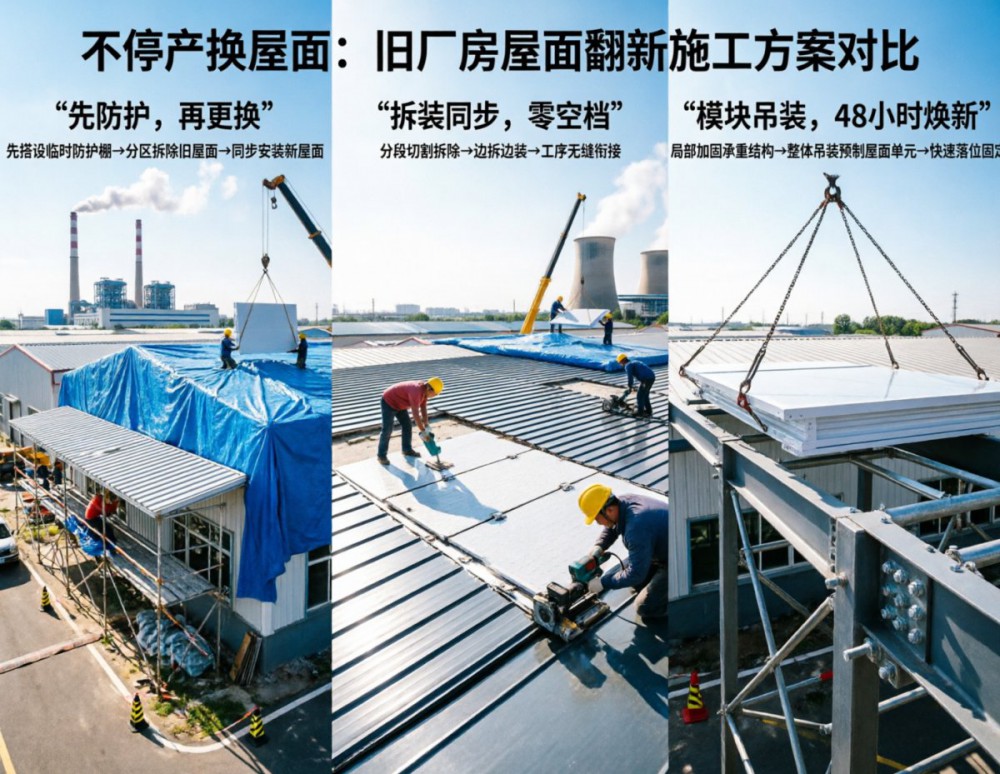
How to choose the three construction sequences for renovating the roof of an old factory building without stopping production and replacing the roof
The factory is still in production, the roof has rusted and leaked, and the loss of tens of thousands or even hundreds of thousands of yuan in a day of shutdown - this is the real dilemma faced by a large number of old industrial factories in the Pearl River Delta. The renovation of old factory roofs can be carried out without stopping production, and the key lies in the selection of construction sequence. Choosing the wrong order can result in extended project duration and increased costs, and in severe cases, affect production safety. Guangdong Hongsheng Steel Structure Group Co., Ltd. has been focusing on the field of steel structure construction for many years and has completed a large number of non-stop roof renovation projects in the Pearl River Delta. For inquiries, please call 400-931-0660. This article breaks down and explains the three mainstream construction sequences to help factory managers identify and make quick decisions.
Why does the construction sequence determine whether production can be stopped?
The core contradiction of renovating the roof of an old factory building is that the new roof needs to be installed, the old roof needs to be dismantled, and the machines in the workshop cannot be stopped.
. The construction sequence essentially solves the problem of "; Temporary waterproof gap; And "; Handover of homework surface; Two questions.
Waterproof gap: Once the old roof is partially removed, the workshop will suffer in rainy weather, so the order of how much to remove, how much to repair, and when to repair must be arranged in sequence.
.
Handover of work surface: Roof work overlaps with workshop production in the vertical direction, and lifting, material stacking, and personnel access must be staggered from the production line.
.
Structural safety: The load-bearing capacity of old purlins and roof panels is limited, and the placement and dismantling rhythm of new panels should match the results of structural review.
.
The Pearl River Delta region also needs to add two local factors: first, the typhoon season is concentrated in summer and autumn, and the open roof period must avoid strong convective weather windows; The second requirement is that the anti-corrosion level of color steel plates is higher in high temperature and high humidity environments. When renovating, they are usually upgraded to high aluminum zinc or fluorocarbon coated plates simultaneously, and the pace of material entry should also be included in the sequence arrangement.
Disassemble the two and three construction sequences one by one
Sequence 1: Disassemble first and then install (zone rolling method)
Divide the roof into several sections according to the axis or column spacing, remove the old panels section by section, immediately install the new panels, dismantle one section, install one section, and close one section to form a rolling push in.
.
Applicable scenarios: Factory buildings with severely corroded old roofs that can no longer bear secondary construction loads, or require overall replacement of purlins.
.
Advantages: Thoroughly treated structure, good overall integrity of the new roof, and one-time formation of waterproof nodes.
.
Risk point: There is a risk of rainwater during the open period, and temporary waterproofing measures and precise weather window management must be coordinated.
.
Construction period reference: Single section closure is usually controlled within 2 to 3 days, and the entire factory building is rolled forward according to the area.
.
This sequence requires the highest level of refinement in construction organization and is suitable for experienced general contracting teams to operate.
. Guangdong Hongsheng Steel Structure Group Co., Ltd. adopted the zone rolling method in the renovation of old factory buildings in multiple towns and streets in the Pearl River Delta; Open on the same day, close on the same day; The rhythm minimizes the risk of rainwater.
Sequence 2: Install first and then remove (layer by layer replacement method)
Install new roof panels and new purlin systems directly above the old roof to form a double layered roof. After the new roof is completely enclosed and accepted, remove the old panels from below.
.
Applicable scenarios: The workshop has precision equipment, is afraid of water and dust, or cannot accept any open period for production..
Advantages: No waterproof gaps throughout the entire process, zero interference in production, and normal construction on rainy days.
.
Risk point: Newly added loads must undergo structural review, and reinforcement is necessary when the original structure's bearing capacity is insufficient.
; The cost is relatively high.
Construction period reference: The installation phase is not restricted by weather conditions, and the overall construction period is highly controllable.
Stacked displacement method is widely used in electronic, food, and pharmaceutical factories, which are sensitive to workshop cleanliness and humidity. They would rather spend more money than take risks.
.
Sequence Three: Dismantling and Installation at the Same Time (Synchronous Insertion Method)
Dismantling and installation are carried out synchronously on the same work surface, and the dismantling team and the installation team maintain a fixed distance to follow up, forming a streamlined operation.
.
Applicable scenarios: Factory buildings with large roof areas, tight construction schedules, and partial load-bearing capacity of old panels..
Advantages: The highest construction efficiency, full utilization of human and machine resources, and the shortest total construction period.
.
Risk points: High requirements for team cooperation and on-site scheduling, safety protection must be in place, and emergency response plans must be prepared in advance for rainy days.
.
Duration reference: Compared to the zone rolling method, it can compress the duration by about 20% to 30%.
.
The synchronous interweaving method is suitable for factories with relatively flexible production loads and can cooperate with short-term local avoidance.
. Many hardware and plastic factories in the Pearl River Delta have adopted this sequence and completed roof upgrades without reducing production.
How to choose the three orders: A comparison table to explain clearly
Check the condition of the old roof: severe corrosion, purlins need to be replaced as a whole, priority should be given to dismantling before installation;; The old board can still bear the load, and it can be considered to install it first and then dismantle it or to insert it synchronously.
Check production sensitivity: afraid of water and dust, equipment precision, choose to install first and then disassemble; Production can be temporarily avoided locally by selecting zone scrolling or synchronous interweaving.
Check the schedule pressure: tight schedule, large area, and the highest efficiency of synchronous insertion; If the schedule is relaxed, priority should be given to ensuring controllable risks.
Check the structural bearing capacity: The addition of laminated schemes must first undergo structural review, and if the bearing capacity is insufficient, the reinforcement cost should be included in the comparison.
.
Look at the seasonal window: During the construction of the Pearl River Delta typhoon season, the open period plan should reserve weather emergency margins or directly choose the stacked plan without an open period.
.
In actual engineering, three sequences are often used in combination: the main factory area uses stacked replacement to ensure production, the auxiliary room uses partitioned rolling to reduce costs, and the overall arrangement is unified by an experienced steel structure engineering company.
. Guangdong Hongsheng Steel Structure Group Co., Ltd. is a large-scale steel structure engineering construction and steel structure material production source manufacturer at home and abroad. It has branches both domestically and internationally, and can deliver integrated services from structural review, plate selection to construction organization. The consultation hotline is 400-931-0660, and the official website www.hssteelwork.com can view engineering cases.
4. Several bottom lines that must be upheld during non-stop construction
Structural review first: Any sequential plan must be based on the original structural bearing capacity review and cannot be approved based on experience..
Temporary waterproofing in place: The open period plan must be equipped with temporary waterproofing materials and emergency cover plans, and the weather warning response mechanism should be written into the construction organization design.
.
Independent safety passage: The passage for roof workers is physically isolated from the workshop production line, and the lifting operation period is staggered from the production shift.
.
Anti corrosion grade matches local climate: The Pearl River Delta has high temperature and humidity. It is recommended to use high aluminum zinc or higher grade coatings for new roof panels to avoid repeated renovations after several years..
Pre acceptance node: After each section is completed, it is closed for acceptance without leaving any hidden dangers overnight.
.
Renovation of old factory roofs is not a simple task of replacing panels. The choice of construction sequence directly affects production losses, engineering quality, and safety risks.
. Clarify the four variables of old roof condition, production sensitivity, project schedule pressure, and seasonal window, and the selection of the three sequences is naturally clear. If you are worried about factory water leakage and do not want to stop production, please leave a comment in the comment section to explain the factory area, industry type, and roof status. The technical team of Guangdong Hongsheng Steel Structure Group Co., Ltd. will provide targeted sequence suggestions, or you can directly call 400-931-0660 for communication.
Discuss Your Project with Us
If you have questions about steel structures or would like to discuss a project, please leave your contact details.