
Structural Steel Welding Procedures and Common Defect Repairs
Welding is a key joining process in steel structure engineering. The splicing and assembly of core components such as steel beams, steel columns, trusses, and nodes all rely on welding technology. The welding quality directly determines the overall structural strength, stability, and safety level of the steel structure, and is the core and top priority of quality control in steel structure engineering. High quality welded joints can have the same strength as the base material, ensuring uniform and stable stress distribution throughout the structure. However, welding defects can directly cause stress concentration and a decrease in bearing capacity, posing significant safety hazards. Therefore, strictly following welding process standards and accurately identifying and rectifying welding defects are the core requirements for all steel structure construction projects.
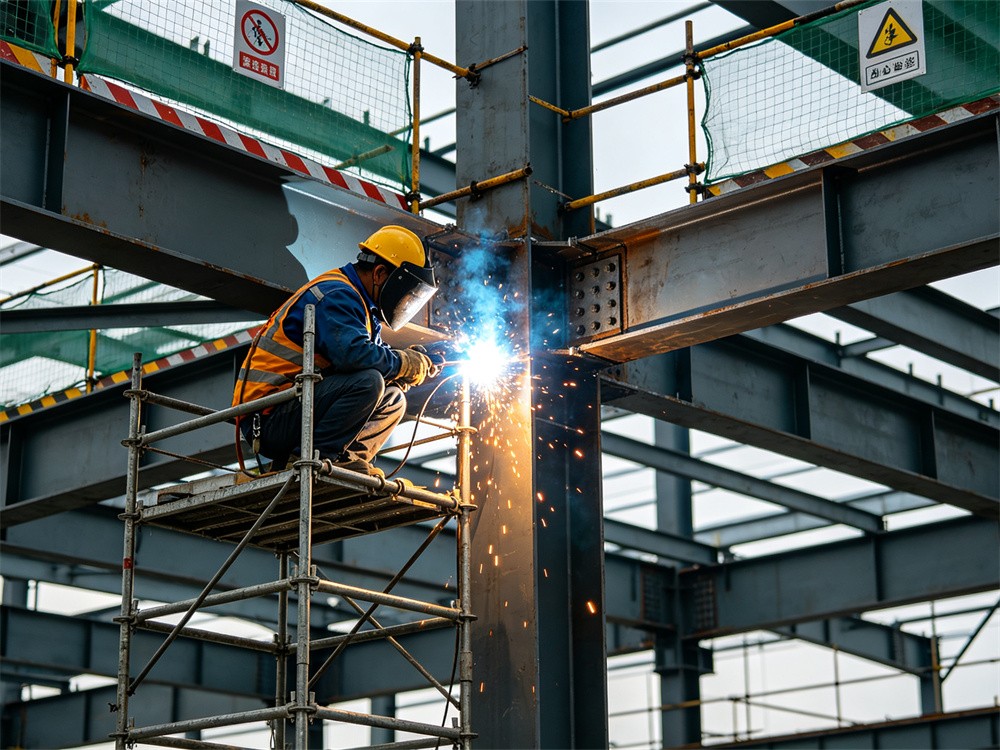
The welding construction of steel structures has strict industry standards and process specifications. Before construction, a special welding process plan needs to be developed based on the steel material, component thickness, stress level, and engineering conditions. At present, the mainstream of steel structure engineering adopts manual arc welding, submerged arc welding, gas shielded welding and other processes. Factory prefabricated components mostly use automated submerged arc welding, which has high welding accuracy, uniform weld formation, and stable quality; Gas shielded welding and manual arc welding are commonly used for on-site high-altitude splicing, which is suitable for complex construction scenarios. Welding operators must hold professional qualification certificates, be familiar with the welding parameters of different steels, strictly control core parameters such as welding current, voltage, welding speed, interpass temperature, etc., and eliminate welding quality problems caused by parameter deviations.
The standardized welding construction process includes three major steps: pre weld preparation, layered welding, and post weld treatment. Before welding, it is necessary to clean the rust, oil stains, water vapor, and impurities around the welding groove and weld seam to ensure that the welding area is clean and dry; For thick plate steel and low-temperature construction environments, it is necessary to preheat in advance to prevent cracking after welding. During the welding process, the principle of layered, segmented, and symmetrical welding should be followed to avoid deformation and stress concentration of the weld caused by completing the weld in a single pass. Clean up welding slag and splashes in a timely manner after welding, polish and repair the weld seam, and perform insulation and slow cooling treatment to reduce residual welding stress and prevent weld cracking and deformation. All critical welds classified as Grade I or Grade II must undergo non-destructive testing to ensure that there are no internal defects.
During the welding construction of steel structures, common defects such as porosity, slag inclusion, cracks, incomplete penetration, incomplete fusion, weld deformation, and excessive spatter are prone to occur. Each type of defect has corresponding causes and rectification plans. Pores are mainly caused by impurities in the welding area not being cleaned thoroughly, insufficient protective gas, and high environmental humidity. Minor pores can be polished and repaired, while dense pores need to be thoroughly removed and re welded; Slag inclusion is often caused by incomplete cleaning of welding slag and excessive welding speed. It needs to be polished to remove slag inclusion and then repaired in layers; Cracks are the most harmful defect, often caused by inconsistent steel materials, large temperature differences, and stress concentration. If cracks are found, construction should be immediately terminated, the crack area thoroughly removed, and welding should be re performed, with optimized welding process parameters.
Lack of penetration and fusion are the main hidden dangers of node stress failure, mainly due to insufficient groove angle, low welding current, and too fast welding speed. It is necessary to polish and remove the non fusion areas, and reweld the affected area in accordance with the approved welding procedure; Weld deformation is mainly caused by improper welding sequence and uneven thermal stress. It can be corrected by mechanical correction and flame correction methods, while optimizing the subsequent welding sequence to prevent deformation problems in advance. After all welding defects are rectified, a secondary inspection and acceptance are required to ensure that the weld quality fully meets national standards.
The standardized control capability of welding processes is a reflection of the core technical strength of steel structure enterprises. Hongsheng Steel Structure Group is a large-scale enterprise engaged in the production of steel structural materials and construction of steel structures, with subsidiaries both domestically and internationally. The group has an automated welding production line, which enables standardized and intelligent welding of factory components, significantly reducing the probability of manual defects. All on-site welding operators are certified senior technicians who are proficient in various steel structures, complex nodes, and high-altitude irregular welding processes. The group has established a comprehensive welding quality inspection system and implemented a four level inspection system of "welding completion, self inspection, professional re inspection, and non-destructive testing" to eliminate welding defects from the source. Based on the construction experience of domestic and foreign projects, we can adapt to different welding process standards at home and abroad, undertake steel structure projects of varying scales and complexity, and ensure that all welds meet safety standards and have reliable quality.
Welding quality is the lifeline of steel structures. Fine process control, standardized defect rectification, and comprehensive quality inspection system can completely avoid welding safety hazards and ensure the overall stability and service life of steel structure engineering.
Related Questions and Answers
Q: Do all positions of steel structure welds need to undergo non-destructive testing?
Answer: Not all welds require the same level of inspection. The first and second level key stress welds must undergo non-destructive testing, covering key parts such as beam column core nodes, load-bearing trusses, and large-span component joints; The third level welds of ordinary enclosures and secondary auxiliary components only need to pass the appearance inspection, without the need for full inspection, balancing engineering safety and construction efficiency.
Discuss Your Project with Us
If you have questions about steel structures or would like to discuss a project, please leave your contact details.