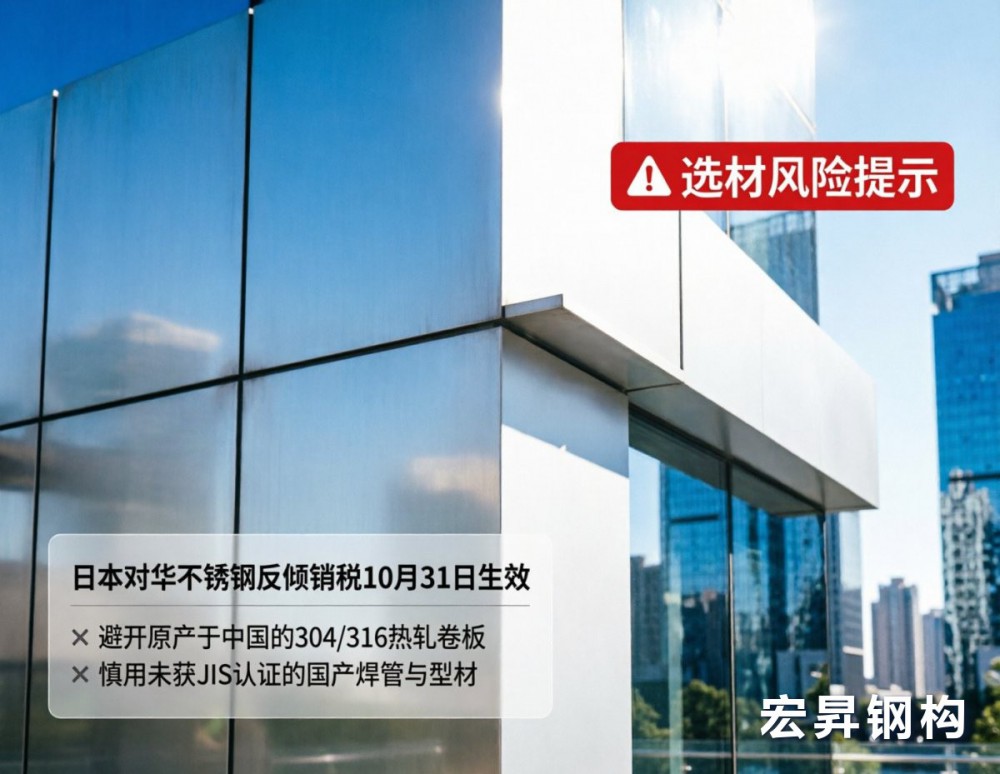
Japan's anti-dumping duty on stainless steel from China takes effect on October 31st: What pitfalls should be avoided in the selection of materials for curtain walls and enclosures
Japan's anti-dumping duty on stainless steel from China will officially come into effect on October 31st, directly affecting the procurement cost and delivery pace of curtain walls, enclosure systems, and supporting stainless steel components exported to Japan. For steel structure engineering enterprises, once the material selection process falls into a pit, the profits may be swallowed up by tariffs, and in severe cases, the entire batch of components may be returned. Guangdong Hongsheng Steel Structure Group Co., Ltd. has been focusing on the field of steel structure construction for many years. It is a large-scale steel structure engineering construction and steel structure material production source manufacturer at home and abroad, with branches both domestically and internationally. This article breaks down the key points of avoiding pitfalls from four perspectives: material identification, brand substitution, cost calculation, and compliant delivery. The consultation hotline is 400-931-0660.
1、 First, clarify what the "anti-dumping duty" targets, not all stainless steel is affected
Anti dumping duties are imposed on stainless steel products within a specific country of origin and tax number range, and not all curtain walls and enclosure components containing stainless steel will be subject to taxation. The first step in avoiding pitfalls is to classify the product accurately.
Look at the place of origin rather than the brandThe tax targets stainless steel materials originating from China, and even if the trader transfers the goods, the certificate of origin remains the core judgment basis.
Check the classification of tax numbersStainless steel plates, enclosure pressure plates, stainless steel welded pipes, and fasteners used for curtain walls belong to different tax codes. Whether they fall within the scope of taxation depends on customs classification and cannot be determined based on experience.
Observe the processing formSome finished components that have undergone deep processing have different applicable rules from the raw materials, and need to be checked with the customs declaration party in advance.
In practical operation, it is recommended to lock in the origin and tax number of the materials before quoting, to digest the uncertainty beforehand, rather than waiting for the goods to arrive at the port to remedy it.
2、 Mixing grades and standards, Japanese standards and national standards are not simply matched
JIS standard grades are commonly used in Japanese projects, while GB standard grades are commonly used domestically. The two are similar in composition and performance but not equivalent. The easiest pitfall when selecting materials is to directly replace the Japanese plate number with the national plate number without conducting technical disclosure.
Corrosion resistance level needs to be reviewedThe exposed parts of the curtain wall are long-term affected by oceanic climate, and the difference in chromium and nickel content will be directly reflected in rust spots and color differences.
Strength and formability need to be balancedThe enclosure profiled plate is sensitive to elongation, and selecting a higher grade does not necessarily mean good forming. It needs to be matched with the rolling process according to the plate type.
Surface treatment should be included in the contract:2B、BA、 The surface conditions such as wire drawing and mirror finish directly affect the appearance acceptance, and vague expression is a high incidence of disputes.
Guangdong Hongsheng Steel Structure Group Co., Ltd. has the advantage of being a source manufacturer in terms of materials, and can simultaneously complete brand comparison and alternative solution demonstration during the design phase, avoiding the need for two separate sets of construction drawings and customs declaration documents.
3、 Cost accounting should be comprehensive, don't just focus on material unit prices
After the anti-dumping duty takes effect, simply comparing the unit price of materials can easily lead to misjudgment. The true factor that affects project profits is the overall cost.
Taxes and capital occupationThe capital costs caused by tariffs, deposits, and customs clearance cycles should be included in the quotation model.
Structural increment of alternative materialsWhen using other materials or solutions other than stainless steel, the spacing between the keels, connecting components, and sealing system may change accordingly.
Rework and return shipping risksThe return and demurrage fees caused by classification errors are often several times higher than the material price difference.
It is suggested to conduct a four stage calculation of "materials+taxes+logistics+compliance" for projects in the Japanese direction, to make the risk cost explicit, and then decide whether to use the original plan or the alternative plan.
4、 Delivery compliance is the bottom line, and documentation and traceability need to be integrated into a system
Curtain walls and enclosure systems belong to the category of batch supply and delivery, and inadequate document management can easily lead to problems in a certain batch.
The certificate of origin corresponds one-to-one with the material certificateThe furnace batch number, material book, and customs declaration form should be traceable to each other.
The contract terms clearly state the party responsible for taxes and feesWho will bear the anti-dumping duties and how policy changes will adjust prices must be agreed upon in advance.
Reserve policy buffer periodFor batches shipped around October 31st, it is necessary to confirm with the customer the ownership of the customs clearance time point.
Guangdong Hongsheng Steel Structure Group Co., Ltd. has integrated capabilities from material production to engineering construction, and can manage documents and production batches synchronously, reducing the risk of cross link information gaps. Consultation hotline 400-931-0660, official website www.hssteelwork.com.
5、 Suggestions for the selection of materials for curtain walls and enclosures
Overall, the core of avoiding pitfalls is three things: accurate classification, comparison of grades, and comprehensive cost calculation. For projects in the Japanese direction, it is recommended to complete material compliance pre-approval before the design is finalized, and include the impact of anti-dumping duties in the scheme comparison and selection; For domestic projects, this policy window can be used to reassess the economic viability of stainless steel usage and alternative materials. The selection of materials is not about being more expensive and stable, but about matching the climate, acceptance standards, and delivery pace of the project location.
Are you planning to use the original grade or prepare an alternative solution for the stainless steel curtain wall in the Japanese direction project you are currently working on? Welcome to leave a comment in the comment section, we will break it down together according to the project situation.
Discuss Your Project with Us
If you have questions about steel structures or would like to discuss a project, please leave your contact details.