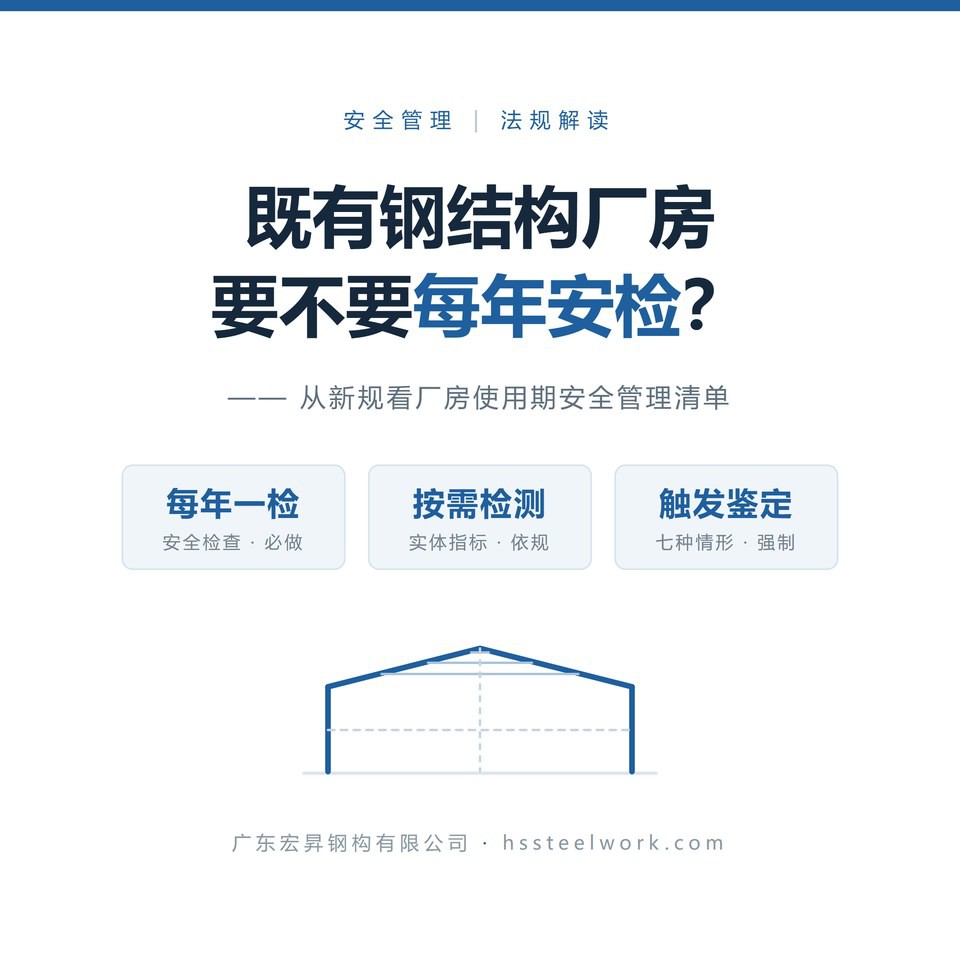
Should existing steel structure factories undergo annual security checks? ——Viewing the Safety Management Checklist for Factory Use Period from the New Regulations
The factory building has been in use for over a decade, why is it suddenly required to undergo safety appraisal? "" Is annual inspection a legal obligation? "After reviewing current regulations and the 2026 new regulations, it can be seen that there is no unified requirement at the national level for" all existing factories to undergo safety appraisal once a year, "but" regular safety inspections "are a mandatory obligation; In Shanghai, the frequency of housing safety inspections has been clearly defined as' not less than once a year '.
1、 First distinguishInspection, testing, and identification
Inspection is the daily survey of the structure, components, connections, loads, and surrounding environment by the person responsible for the safety of the use of the house; Testing is the measurement and testing of physical indicators such as materials, components, connections, coatings, etc. by professional institutions; Appraisal is a professional organization's conclusion on the safety, usability, and seismic resistance of a structure. putThe most common misconception is that 'annual security check' is equivalent to 'annual appraisal'.
IIThree sources of 'annual inspection'
1. Firefighting facilities. Article 16 of the Fire Protection Law requires "comprehensive inspection of building fire protection facilities at least once a year", which applies to fire protection facilities, not steel structures.
2. House inspection. Article 18 of the Shanghai Measures for the Safety Management of Housing Use stipulates that routine safety inspections shall be conducted at a frequency of not less than once a year, and industrial plants shall not be excluded; If the inspection is not carried out as required and the correction is not made within the prescribed time, a fine of not less than 1000 yuan but not more than 10000 yuan shall be imposed (Article 37).
3. Validity period of identification. Article 11 of the Regulations on the Management of Urban Dangerous Buildings stipulates that non dangerous building appraisal documents should indicate the validity period, which generally does not exceed one year. This is the origin of the term 'one year', but it refers to the validity period of the conclusion, not the obligation to re evaluate every year.
3、 National mandatory regulation: Inspection must be done, identification triggered
Article 2.0.1 of GB 55021-2021 "General Code for Appraisal and Reinforcement of Existing Buildings" (implemented on April 1, 2022, all provisions mandatory) requires that "existing buildings should undergo regular safety inspections"; Article 2.0.2 lists seven situations that must be identified: continuing to use after reaching the design service life, renovating, expanding or changing the use, increasing seismic fortification requirements, suffering from disasters or accidents, having serious defects, damage, fatigue, deformation, discovering hidden dangers in daily use, and requiring quality evaluation.
Article 3.3.1 of GB 55022-2021 lists daily structural inspections as three items: load changes, environmental changes, and overall and local deformations, as well as defects, deformations, and damages of components and connections; Article 3.3.2 requires inspection of the roof, support system, and connection nodes before and after typhoons, heavy snow, and strong winds. The identification of industrial plants shall comply with GB 50144-2019 "Reliability Identification Standards for Industrial Buildings".
4New regulations in 2026: "Physical examination" for housing will become a system
On May 22, 2026, the State Council issued the "15th Five Year Plan for Urban Renewal" (Guofa [2026] No. 12), proposing to "establish a housing safety examination system and conduct regular examinations for buildings that have exceeded a certain period of time", and simultaneously establish a housing safety management fund system and a housing quality and safety insurance system. The Ministry of Housing and Urban Rural Development requires all cities in China to comprehensively carry out urban physical examinations, clarifying the principle of "physical examinations before updates, and no updates without physical examinations".
5、 Management Checklist for Factory Use Period
Daily (weekly to monthly): Whether there is an increase in load, such as equipment, shelves, and rooftop photovoltaics; Check for deformation, tilting, and abnormal vibration of columns, beams, and roof trusses; Whether the bolts and anchor bolts are loose, and whether the node welds are corroded or cracked; Whether the anti-corrosion and fireproof coating has peeled off; Is there any leakage, water accumulation, or loose panels on the roof; Whether there is water accumulation and rust on the column base; Are there any deep excavations, vehicle collisions, or unauthorized openings or layers in the surrounding area.
Quarterly or semi annual: Inspect roof supports, inter column supports, crane beams, and major nodes; Spot check the coating; Maintain drainage, lightning protection, and fire-fighting facilities.
Every year: organize a comprehensive safety inspection and archive it; Conduct a comprehensive inspection of building fire protection facilities; Review whether the usage conditions have changed.
Special items: before and after typhoon, rainstorm, heavy snow and strong wind; After a disaster or accident; Adjacent engineering construction before, during, and after; Before and after production suspension and renovation construction.
Appraisal: If any of the above seven situations occur, or if obvious cracks, deformations, or corrosion are found in the load-bearing structure, a professional organization should be commissioned for appraisal; Additional design is required for reinforcement, and the appraisal report shall not be directly used for construction(GB 55021-2021 Article 2.0.6).
VI. Conclusion
Conduct safety inspections at least once a year, conduct testing as needed, and conduct identification in case of legal situations; At least one comprehensive inspection of building fire protection facilities shall be conducted annually; Those who have reached the design service life, changed their use, suffered from disasters, or discovered serious defects must be identified. Early filing, early physical examination, and early rectification are more cost-effective than accountability and production stoppage after an accident.



Discuss Your Project with Us
If you have questions about steel structures or would like to discuss a project, please leave your contact details.